


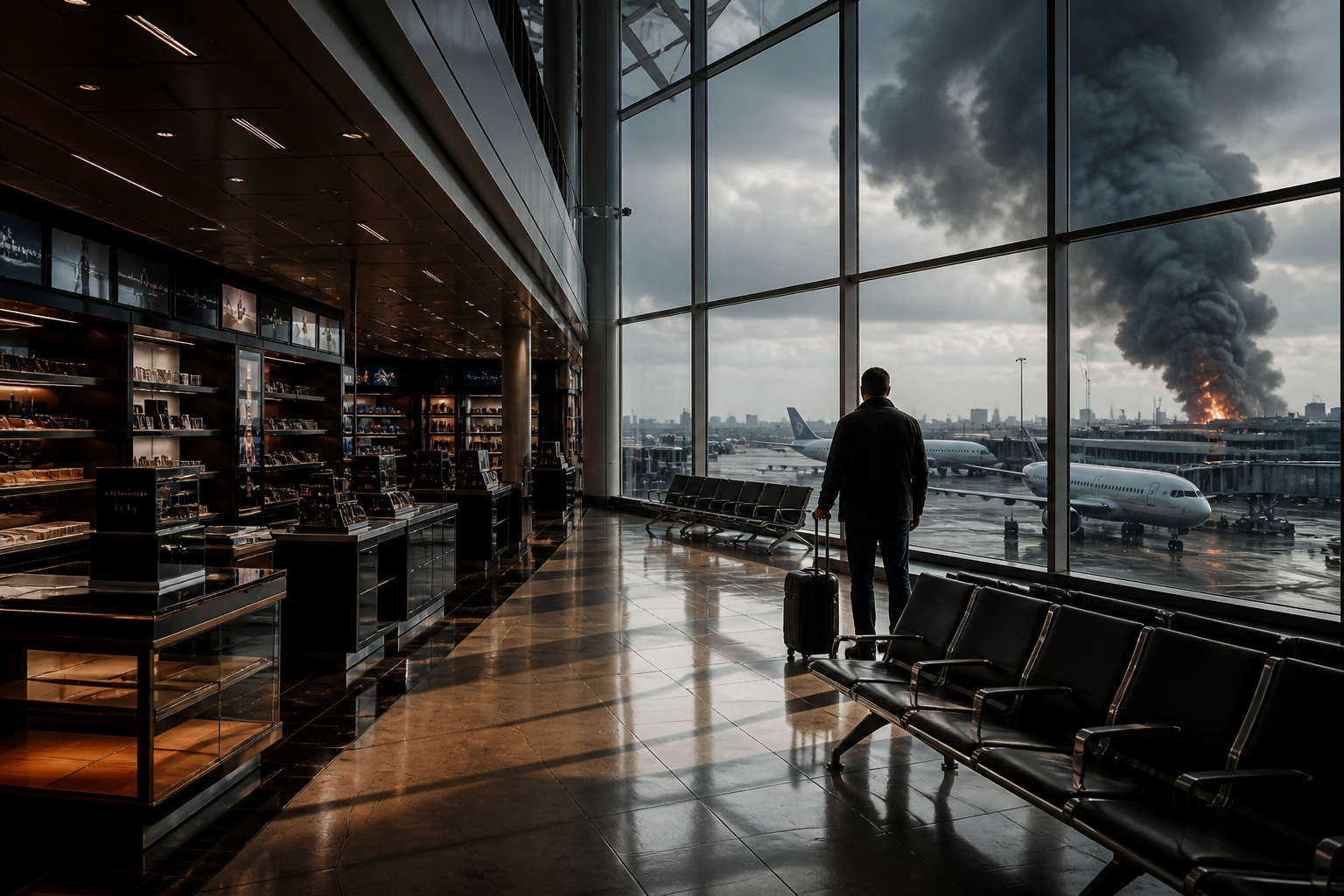
A significant downward revision of the annual profit forecast was announced by the British retailer WH Smith on Thursday, accompanied by a formal suspension of dividend payments. This fiscal adjustment resulted in a sharp contraction of the company’s market valuation, with share prices documented to have fallen by as much as 17% during the session. The primary cause for this deterioration was identified as the ongoing regional conflict involving Iran, which is reported to have exerted a substantial negative impact on both international air travel and broader consumer discretionary spending. The volatility associated with the hostilities has manifested in the form of flight cancellations, widespread diversions, and elevated jet fuel costs, all of which have contributed to a discernible decline in passenger throughput and spending across global airport hubs.
The organization, which maintains a pervasive presence in high-traffic transit environments such as airports and railway stations, indicated that an immediate recovery in passenger numbers and per-capita spending is not currently anticipated. It was noted that while like-for-like sales had experienced a marginal increase of 2% during the initial weeks of the financial year’s second half—a period that coincided with the commencement of hostilities—the subsequent disruption to travel patterns has since reversed that momentum. Observations were provided by the Chief Financial Officer regarding a noticeable reduction in the average “basket size,” or the total amount spent per passenger. This trend was attributed to a decrease in long-haul flight frequency, which traditionally drives the sale of specific travel-related accessories. It was cited that items such as neck pillows, which are typically purchased by travelers embarking on extended journeys, have seen a marked decline in demand as the duration and reliability of international routes have been compromised.
Although the specific metrics for current average basket sizes were not disclosed, it was recalled that during the 2025 financial year, the average spend per passenger within the United Kingdom’s aviation business—the company’s largest market—had achieved a growth of 4%. The current reversal of this trend has necessitated a recalibration of the institution’s earnings expectations. The full-year headline profit before tax and non-underlying items is now projected to fall within the range of 90 million pounds to 105 million pounds. This represents a significant decrease from the previous estimate of 100 million pounds to 115 million pounds, signaling a more cautious outlook for the remainder of the 2026 fiscal year.
The decision to suspend dividend payments is viewed as a mechanical necessity intended to preserve liquidity amidst the prevailing economic uncertainty. Market analysts have suggested that the retailer is likely to be valued with a high degree of caution in the short term, as investors grapple with the dual pressures of regional war and domestic fiscal challenges. The latest update has served to exacerbate existing concerns surrounding the more than 230-year-old institution. These anxieties were initially triggered in August following the discovery of inflated earnings within the North American division, an event that led to the resignation of the Chief Executive Officer and initiated a formal investigation by the United Kingdom’s financial regulatory authorities. It was confirmed on Thursday that cooperation with the watchdog remains ongoing as the organization seeks to resolve these legacy administrative issues.
The challenges faced by the retailer reflect a broader vulnerability within the travel infrastructure sector to external shocks. In the “Muskonomy” of the mid-2020s, where global supply chains and travel networks are increasingly susceptible to rapid geopolitical shifts, the ability of transit-based retailers to maintain profitability is heavily dependent on the stability of international borders and energy prices. The transition from a period of robust post-pandemic recovery to one of wartime disruption has forced a realignment of corporate strategy. For a business model predicated on the convenience of the traveler, the curtailment of movement represents a fundamental threat to operational viability.
Furthermore, the general concerns regarding rising inflation, spurred by the energy crisis linked to the Middle East conflict, have acted as a secondary deterrent to consumer spending. As the cost of living increases, the appetite for incidental purchases at travel terminals has diminished. The suspension of dividends and the reduction of profit targets are interpreted as defensive measures aimed at navigating a period of profound instability. As the 2026 fiscal cycle continues, the focus of the organization will likely remain on cost containment and the optimization of its presence in domestic rail markets, which are perceived as slightly more insulated from the fluctuations of international air travel.
Ultimately, the situation documented on Thursday serves as a definitive illustration of the fragility of the travel retail sector in a fractured global order. The convergence of regulatory scrutiny and geopolitical crisis has placed the venerable retailer in a position of significant strategic difficulty. The ability of the institution to restore investor confidence will depend not only on the resolution of the ongoing investigation into its North American operations but also on a broader de-escalation of regional conflicts that currently restrict the free movement of global passengers. For now, the narrative remains one of institutional caution and the prioritization of fiscal stability over growth in an unpredictable macroeconomic environment.