



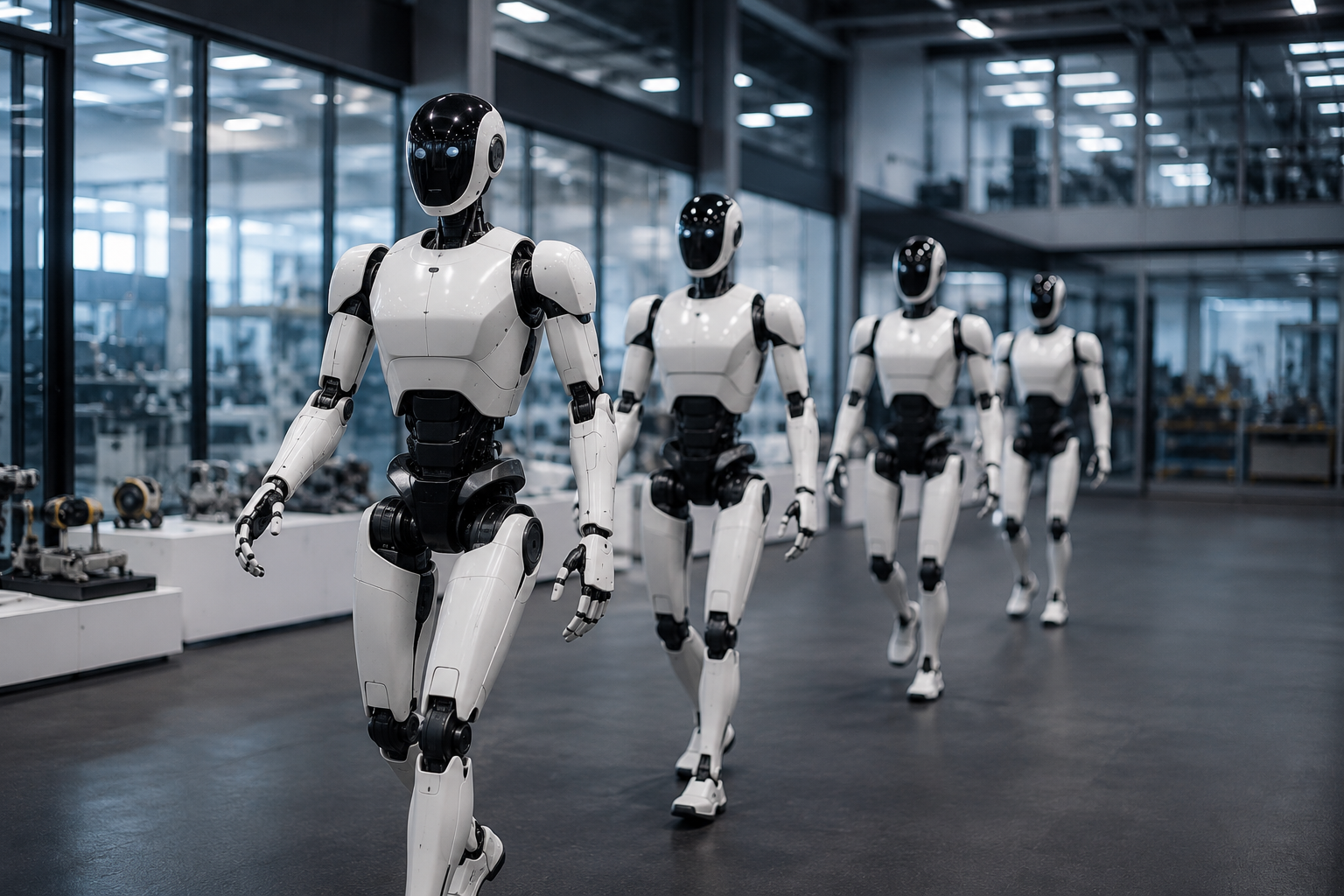
The humanoid robotics industry could be approaching a major breakthrough similar to the transformation created by ChatGPT, according to Wang Xingxing, founder and CEO of Chinese robotics company Unitree. Speaking at the 2026 World Robot Conference in Beijing on August 20, Wang said advances in artificial intelligence could soon allow robots to operate more independently in unfamiliar environments.
Unitree has become one of China’s most prominent humanoid robotics companies, and its recent Shanghai stock market debut has highlighted the growing investor interest in the sector. The company’s shares surged nearly sixfold on their first trading day before falling 11% on Thursday, reflecting the sharp volatility surrounding the emerging robotics industry.
Wang said the sector is moving toward what he described as a “ChatGPT moment” in embodied intelligence. ChatGPT’s breakthrough in late 2022 helped trigger widespread adoption of generative AI and significantly influenced the global technology economy. Robotics, however, has yet to experience an equivalent turning point.
According to Wang, the critical breakthrough would come when robots are able to enter unfamiliar homes or other environments and carry out a wide range of tasks based only on voice or text instructions. He said Unitree hopes robots could eventually perform approximately 80% of household tasks autonomously.
Such a development, he suggested, would represent an important turning point for the industry and could lead to rapid expansion in demand for robotic systems.
Despite his optimism, Wang offered a cautious assessment of current technology. He said a substantial improvement in robotics software could emerge within two to three years under an optimistic scenario, while the latest major breakthrough could take as long as five to 10 years.
Georg Stieler, head of automation at robotics consultancy Stieler, noted that Wang’s assessment was considerably more restrained than the excitement surrounding the World Robot Conference and Unitree’s spectacular initial public offering.
Unitree is currently the world’s largest producer of robot dogs and ranks second globally among humanoid robot manufacturers by shipments, according to industry data. The company became widely known through demonstrations of robots performing choreographed dances and kung-fu routines on Chinese television. Its machines are also increasingly being used in industrial environments, although its IPO prospectus indicates that universities and research institutions still account for most of its customers.
Wang He, founder of Chinese robotics startup Galbot, offered another timeline for the sector’s expected transformation. He predicted that the industry could reach its own “ChatGPT moment” by 2028. He defined that milestone as the point when robots are capable of completing roughly 70% to 80% of everyday tasks without requiring specialized training.
Unitree is placing substantial resources behind the development of world models, which are AI systems designed to help machines understand and respond to physical environments. Wang Xingxing said the company’s largest current investments in terms of both personnel and capital are focused on these technologies. However, he acknowledged that the company and the wider industry remain behind in applying physical AI models to real-world situations.
Humanoid robots, he said, are still not sufficiently capable for widespread commercial deployment. The limitations of AI models responsible for decision-making and interactions remain one of the industry’s biggest challenges.
China nevertheless has established a dominant position in the global humanoid robotics market. A Chinese humanoid industry organization said on Thursday that more than 40,000 humanoid robots were delivered in China during the first half of 2026. The country accounted for 97% of worldwide humanoid robot shipments during that period.
The Chinese government sees robotics as a potential way to address labor shortages and demographic pressures. Robots could eventually take over repetitive, low-value and dangerous work as the country’s workforce shrinks. Humanoid machines are already being introduced in factories and logistics warehouses, although they remain less efficient than human workers in most applications.
The technology has also become part of the broader U.S.-China competition over advanced technologies. Last month, the U.S. Federal Communications Commission prohibited future imports of foreign-made humanoid and quadruped robots, citing national security concerns. The decision represented a significant setback for Chinese robotics manufacturers seeking international markets. At the World Robot Conference, several Chinese robotics companies told Reuters that they were nevertheless seeking opportunities to expand overseas.