

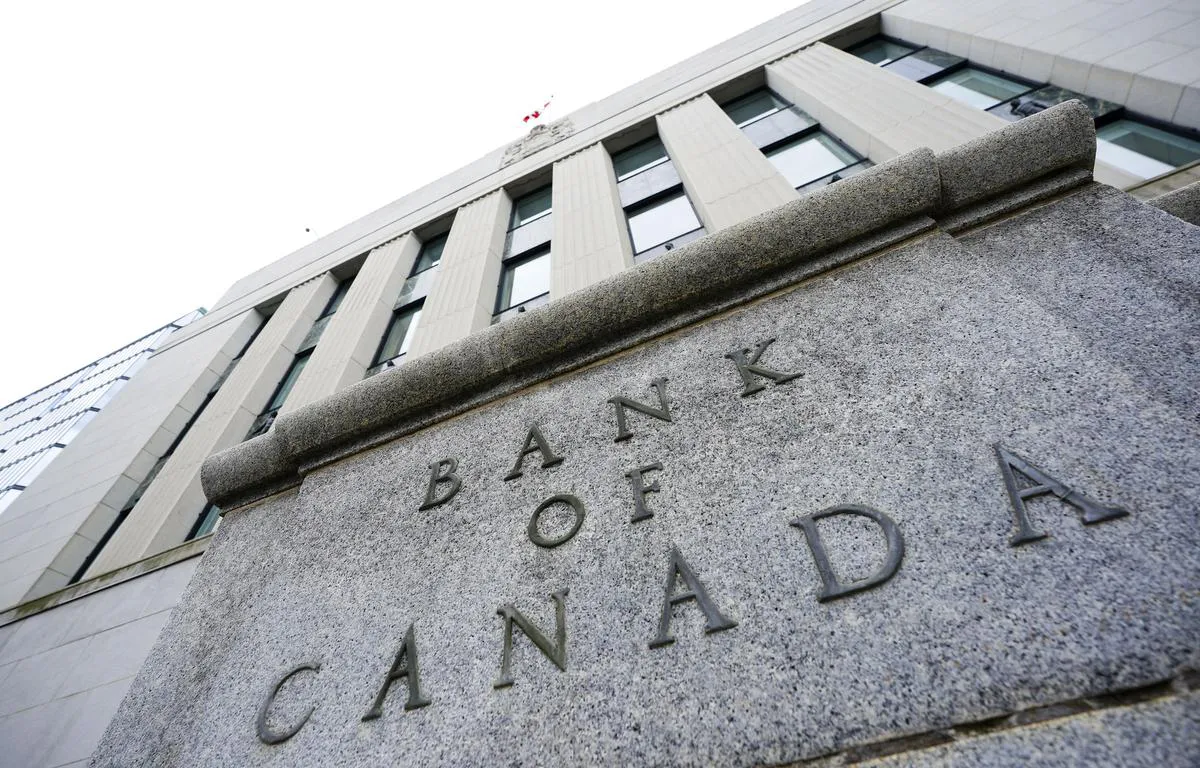
The Bank of Canada made a significant decision on Wednesday by raising its overnight rate to 4.75%, marking the highest level in 22 years.
This move immediately sparked forecasts from markets and analysts, predicting another increase in the following month to address an overheating economy and stubbornly high inflation that has persisted.
After a series of eight rate hikes since March 2022, which brought borrowing costs to a 15-year high of 4.50%, the central bank had maintained a hold on rates since January.
This pause allowed the bank to assess the impact of the previous rate adjustments.
Nonetheless, the recent communication from the central bank recognized the presence of unexpectedly robust consumer expenditure, a resurgence in service demand, an upturn in the housing sector, and a labour market characterized by scarcity.
These factors indicated that excess demand was more persistent than initially anticipated.
The Bank of Canada expressed concerns about an uptick in inflation observed in April, as well as the sustained high levels of core inflation.
It raised the alarm that there is a potential for consumer price index (CPI) inflation to remain significantly above the bank’s 2% target.
In light of these developments, the governing council determined that monetary policy needed to be more restrictive to bring supply and demand back into balance and achieve sustainable inflation levels.
The announcement had an immediate impact on the Canadian dollar, which saw a 0.4% increase in value. It was trading at 1.3350 against the U.S. dollar, reaching its strongest level in four weeks at 1.3322.
Money markets have reacted by pricing in a 60% probability of another rate hike in July and fully factoring in further tightening by September.
Derek Holt, the vice president of capital markets economics at Scotiabank, predicted another 25 basis points increase in July.
He compared the situation to opening a bag of chips, where one cannot stop after having just one. This implies that further rate hikes may be necessary to achieve the desired impact on demand.
The final time the Bank of Canada’s rate touched 4.75% was in April & May of the year 2001.
BoC Deputy Governor Paul Beaudry is scheduled to speak and field questions from the media in British Columbia on Thursday, providing additional insights into the central bank’s decision-making process.
During a conversation with the parliamentary caucus, Pierre Poilievre, the leader of Canada’s main opposition Conservative Party, criticized Liberal Prime Minister Justin Trudeau.
Poilievre held Trudeau responsible for driving inflation through deficit spending and leading the country towards a potential full-scale financial crisis.
In response, Canada’s Finance Minister Chrystia Freeland attributed the surge in prices to the economic recovery following the COVID-19 pandemic and the impact of Russia’s invasion of Ukraine.
Freeland expressed confidence in Canada’s position, stating that no country is better positioned for a soft landing than Canada. She reassured reporters that the country is very close to the end of this difficult time and expects a return to low, stable inflation and strong, steady growth.
The month of April witnessed an acceleration in annual inflation for the first time in 10 months, reaching 4.4%.
Additionally, the first-quarter GDP surpassed the Bank of Canada’s forecast with a 3.1% rise. Looking ahead, the economy is expected to expand by 0.2% in April.
Andrew Kelvin, the chief Canada strategist at TD Securities, acknowledged the Canadian economy’s remarkable resilience throughout 2023.
He also predicted another rate hike in July, emphasizing the need for further tightening to reduce demand and achieve the Bank of Canada’s 2% inflation target.
While the Bank of Canada still anticipates inflation to slow down to 3% during the summer, it did not reiterate its previous forecast that inflation would gradually reach its 2% target by the end of the year.