



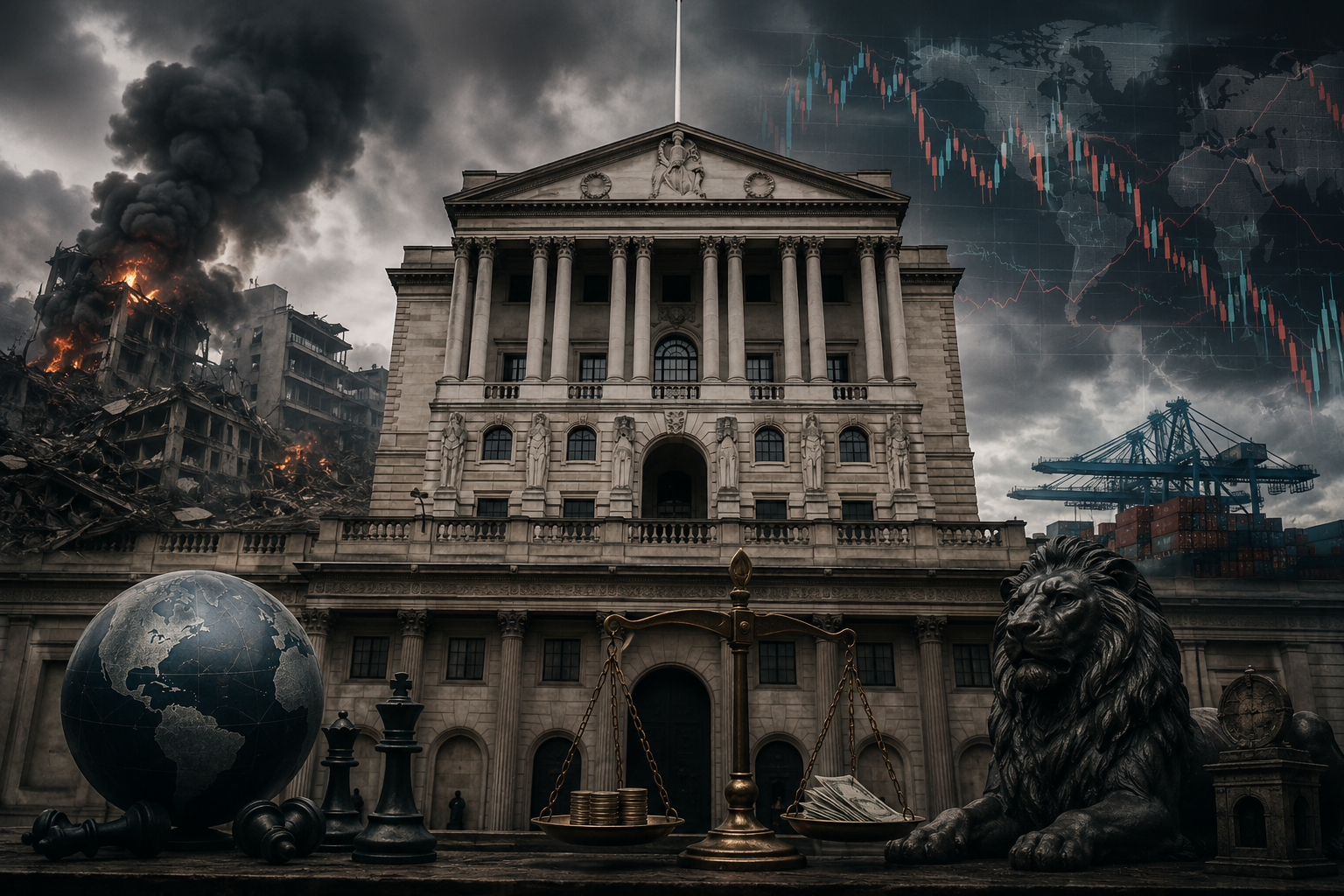
A significant caution was articulated on Monday by a prominent member of the Bank of England’s Monetary Policy Committee, Megan Greene, who argued that central banking authorities must not operate under the assumption that the inflationary pressures generated by the military conflict involving Iran will be merely transitory. It was asserted during a financial forum hosted in London that macroeconomic policymakers cannot afford the luxury of waiting for definitive empirical evidence regarding the full economic impact of the crisis before adopting a decisive stance on benchmark interest rates. This latest geopolitical disruption was characterized as the third major negative supply shock to be inflicted upon the global economy within a five-year window, a structural reality that necessitates deep institutional concern regarding the future trajectory of domestic wage-setting and corporate pricing behaviors.
The traditional economic doctrine dictating that central banks should look through temporary supply-side disruptions was explicitly challenged during the address. It was posited that while such a passive approach may have been appropriate for isolated incidents, the consecutive nature of recent global shocks has rendered that conventional framework an outdated piece of economic folklore that should no longer guide contemporary monetary strategy. Although a vote had been cast by the policymaker alongside the majority of the Monetary Policy Committee to maintain borrowing costs at their existing elevated levels during the April deliberations, it was subsequently acknowledged that additional tightening of monetary policy through interest rate increases might become necessary in upcoming institutional sessions.
The underlying mechanics of this hawkish assessment are deeply rooted in the anticipated secondary effects of the current energy market volatility. It was explained that the broader consequences of escalating fuel and electricity costs—such as intensified demands from the domestic workforce for compensatory wage increases or widespread upward adjustments to retail prices by corporations—typically require an extended duration of approximately twelve months before becoming fully visible in official economic reports. Consequently, a preemptive policy posture was advocated to prevent these secondary inflationary dynamics from becoming deeply embedded within the domestic financial fabric.
In a separate series of economic commentary, another influential member of the Monetary Policy Committee, Catherine Mann, indicated that close observation is being maintained over incoming macroeconomic data to properly evaluate the expanding upside risks to the nation’s inflation outlook. Particular emphasis was placed on the impending publication of official consumer price index figures, alongside more forward-looking sentiment indicators, to determine the systemic persistence of domestic price pressures. Furthermore, external complications stemming from domestic political developments were integrated into the broader growth equation during an international central banking conference held in Budapest. It was observed that prolonged ambiguity surrounding the political future of British Prime Minister Keir Starmer could begin to exert a perceptible drag on the wider macroeconomic apparatus.
The relationship between political stability and private sector confidence was heavily emphasized, with observations indicating that institutional instability of any variety remains fundamentally deleterious to the essential decision-making processes of both commercial enterprises and private households. Such environments naturally foster a cautious and defensive mentality among economic agents, leading to a deferral of major capital investments and consumer expenditures, a behavioral shift that is traditionally associated with stagnating domestic productivity and weak economic expansion.
These contrasting viewpoints from within the central bank’s inner circle are unfolding against a backdrop of divergence between financial market pricing and mainstream academic consensus. Short-term derivative traders are currently positioning for at least two additional interest rate hikes by the Bank of England before the conclusion of the calendar year, driven by fears of structural inflation. Conversely, a substantial majority of independent economists surveyed in a recent comprehensive poll expressed the view that borrowing costs will likely be kept unchanged for the foreseeable future as policymakers attempt to balance inflation containment against the preservation of fragile economic growth.