



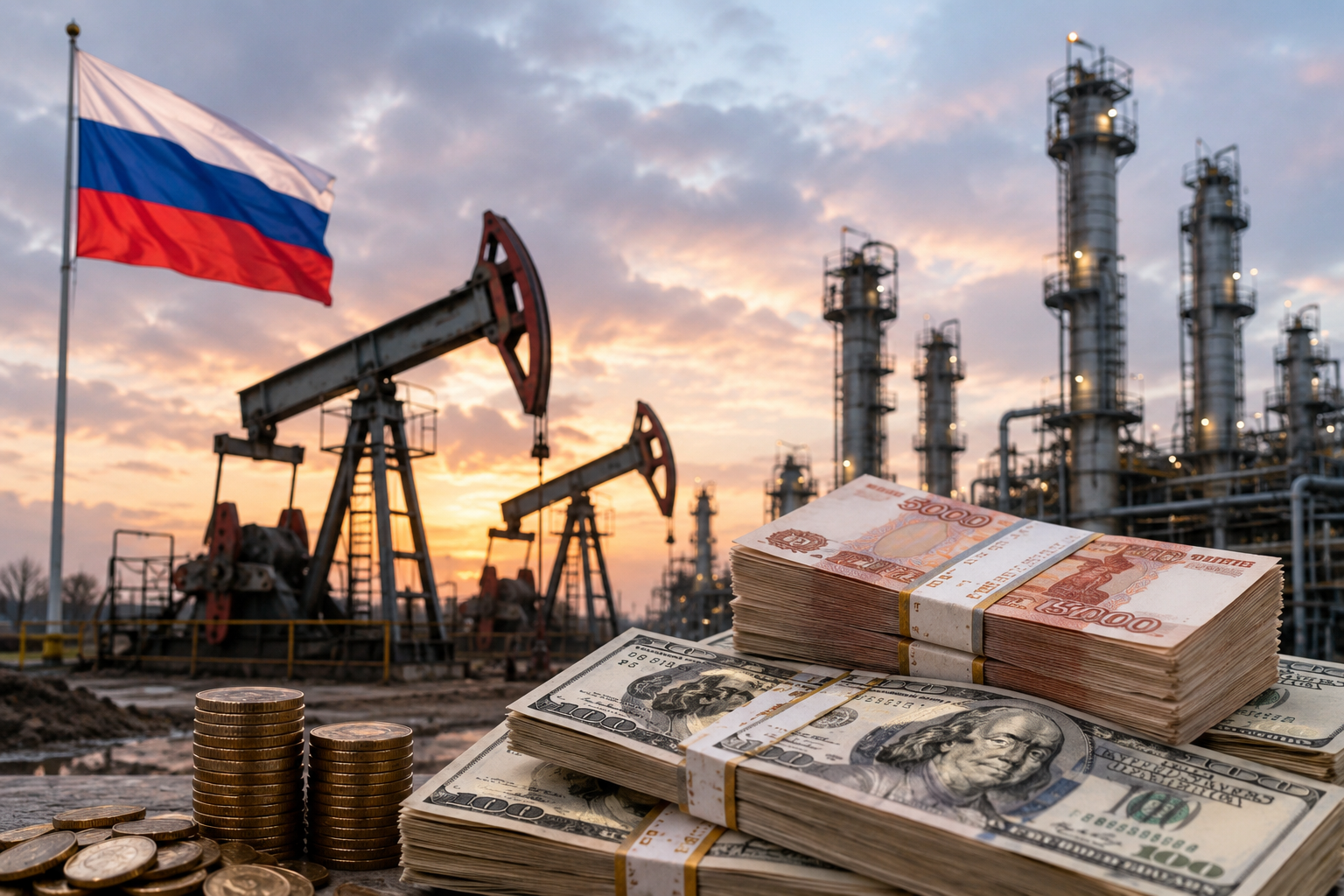
A decision to resume foreign currency purchases for the first time since the beginning of the war in Ukraine was announced by Russia as rising global oil prices boosted government revenues from crude exports. According to a statement released by the country’s Finance Ministry, foreign exchange purchases would be carried out over the coming month through the National Wealth Fund, marking a significant shift in Russia’s financial strategy after months of suspended operations linked to sanctions pressure and weaker oil income.
The announcement reflected the impact of sharply higher energy prices caused by instability in the Middle East and the ongoing conflict involving Iran. Global oil prices had surged after disruptions to shipping and energy supplies intensified following the blockade of the Strait of Hormuz, a route through which a substantial portion of the world’s oil and liquefied natural gas is transported.
According to the Finance Ministry, foreign currency worth approximately 110.3 billion roubles, equivalent to around $1.46 billion, would be purchased between May 8 and June 4. Most of the purchases were expected to involve Chinese yuan rather than Western currencies, reflecting Russia’s increasing reliance on financial cooperation with China since sanctions were imposed by Western countries following the conflict in Ukraine.
The foreign currency acquisitions were said to be intended for Russia’s National Wealth Fund, which functions as a reserve mechanism designed to stabilize the federal budget during periods of economic volatility. The purchases were also viewed as an effort to prevent the Russian rouble from strengthening excessively against other currencies, a development that could negatively affect export competitiveness and reduce state revenues from energy sales.
Despite the announcement, the rouble strengthened by approximately 0.9% against the Chinese yuan during trading on the Moscow Exchange. Market participants and analysts reportedly interpreted the government’s planned purchases as less aggressive than anticipated, leading to continued confidence in the Russian currency rather than immediate weakening pressure.
The actual foreign exchange operations are expected to be conducted by the Central Bank of Russia on behalf of the government. When combined with the central bank’s own financial operations, the state’s net foreign currency purchases were projected to amount to around 1.18 billion roubles per day. This represented a notable change compared with the current pace of foreign currency sales, which had been running at approximately 4.6 billion roubles per day.
Economists and financial analysts observed that the scale of the planned purchases was significantly lower than many had expected. Some analysts had projected daily purchases in the range of 14 billion to 18 billion roubles based on recent oil price increases and assumptions regarding higher state energy revenues.
The smaller-than-expected volume of purchases was interpreted by some experts as an indication that Russia’s oil and gas revenues during April may not have risen as strongly as international oil prices alone would have suggested. Although global crude prices climbed well above $100 per barrel, Russia’s ability to fully benefit from the surge appeared to have been constrained by several operational and geopolitical factors.
Among the reasons identified for lower-than-expected windfall revenues were Ukrainian drone attacks targeting Russian ports and oil refineries. These attacks reportedly disrupted parts of the country’s energy infrastructure and forced reductions in oil production during April. As a result, Russia’s capacity to increase exports and capitalize fully on elevated international oil prices was believed to have been limited.
Another major factor affecting revenues was the substantial level of financial support being provided by the Russian government to domestic oil companies. Payments were reportedly increased in order to keep gasoline prices under control within the domestic market and to reduce inflationary pressure on Russian consumers. These subsidies, together with excise duty rebates, were said to have totaled approximately 208 billion roubles.
Government data reportedly showed that Russia received only around 21 billion roubles in additional oil-related revenues during April despite the surge in global energy prices. The relatively modest increase highlighted the extent to which operational disruptions, subsidies, and sanctions-related discounts continued affecting the country’s energy sector.
Many market observers had previously suggested that Russia could emerge as one of the primary beneficiaries of the sharp rise in oil prices triggered by the conflict involving Iran. Since the beginning of military escalation at the end of February, disruptions to energy transportation routes and heightened geopolitical tensions had contributed to a significant increase in global crude prices.
However, the financial benefits for Russia were complicated by ongoing Western sanctions that continue to force Russian oil exports to trade at discounted prices compared with international benchmarks. These sanctions-related discounts have limited the country’s ability to fully capture the gains associated with rising energy markets.
Russia’s budget policy is governed by a fiscal rule under which foreign currency is purchased for the National Wealth Fund when oil prices exceed a specified threshold. The current cut-off level has been set at approximately $59 per barrel. When prices remain above that level, surplus tax revenues generated from oil exports are directed into reserve funds through foreign currency purchases.
Conversely, when oil prices fall below the threshold, the government sells foreign currency from the wealth fund in order to compensate for budget deficits and stabilize public finances. Earlier in the year, operations involving the wealth fund were suspended after prices for Russian oil declined due to sanctions-linked discounts and weaker market conditions.
The suspension of transactions in February had been intended to prevent excessive depletion of reserve funds during a period of lower revenues. However, after oil prices surged following disruptions in the Strait of Hormuz, some analysts began questioning whether continued suspension of purchases had contributed to the rouble becoming overvalued relative to underlying economic conditions.
The Finance Ministry also stated that deferred transactions from earlier months would be taken into account when calculating purchase volumes for May. Transactions that would have involved foreign currency sales during March were expected to offset part of the planned purchases, thereby reducing the immediate impact on currency markets.
Overall, the resumption of foreign currency purchases reflected the complex balancing act being managed by Russian financial authorities as they attempt to stabilize the economy amid sanctions, geopolitical uncertainty, fluctuating oil markets, and continued military conflict. While higher energy prices have provided temporary relief for government revenues, operational disruptions, currency management challenges, and international economic pressure continue shaping Russia’s broader financial outlook.