



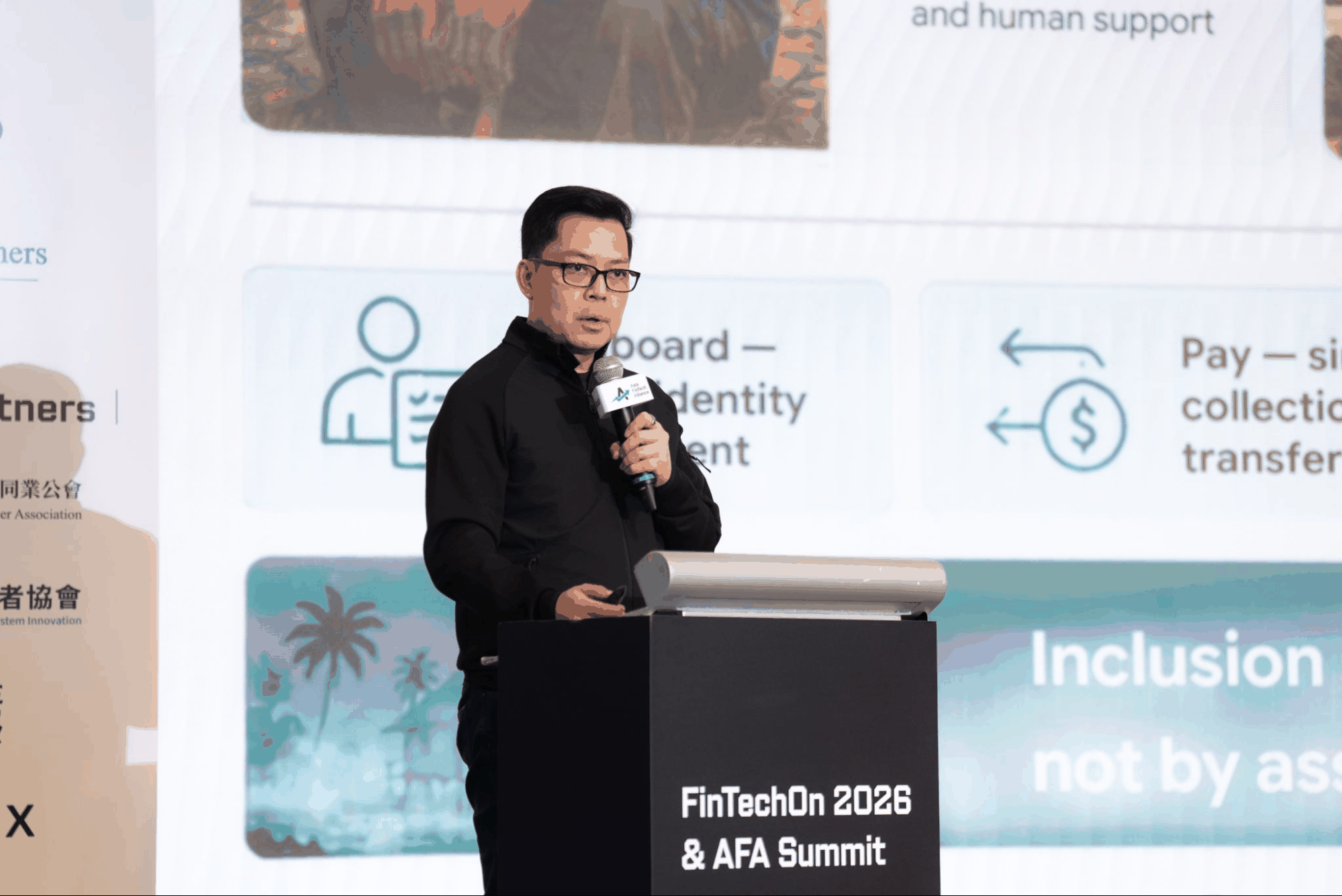
TAIPEI CITY, TAIWAN — FinTech Alliance PH is calling on fintech companies and financial institutions across Asia to join an industry-led pilot aimed at expanding access to digital financial services in rural and underserved communities across Southeast Asia.
The invitation was made by Lito Villanueva, Global Ambassador of Asia FinTech Alliance, Founding Chairman of FinTech Alliance PH and Executive Vice President and Chief Innovation and Inclusion Officer of Rizal Commercial Banking Corporation (RCBC), during his keynote address at the Asia FinTech Alliance (AFA) Summit 2026 in Taipei on Sept. 3.
Villanueva proposed that FinTech Alliance PH and the Asia FinTech Alliance work with two to three institutions to develop and test a last-mile financial inclusion ecosystem that can eventually be scaled across ASEAN markets via secured and sustainable AI-enabled APIs banking platform.
“Asia’s digital economy is racing toward US$1 trillion by 2030. Digital payments already account for over half of all transactions in our region. But here is the uncomfortable truth: over 97% of our enterprises are MSMEs, and too many of them remain outside the system we have built,” Villanueva said.
He said the next phase of digital financial inclusion should focus not only on developing digital products, but on connecting the infrastructure, institutions and channels needed to reach customers in areas where access remains limited.
“AI needs infrastructure that lets it act safely across the real economy. That is where APIs and open finance come in. They connect the channels people actually use from branches and agents to mobile apps, QR codes, and merchants with what AI can power: onboarding, payments, savings, lending, service, and compliance,” Villanueva said.
The proposed pilot will focus on identifying a specific last-mile use case, connecting the relevant players across the ecosystem, testing the solution, measuring its outcomes and determining how it can be scaled.
“FinTech Alliance PH, together with the Asia FinTech Alliance, is inviting two to three institutions to co-create an ecosystem-led pilot for last-mile financial inclusion across ASEAN,” Villanueva said.
“The pilot is simple: identify a real use case, connect the ecosystem, run a focused pilot, measure outcomes, and scale,” he added. “We are looking for better access for last-mile customers, faster onboarding, stronger data and compliance, and new growth for participating institutions.”
Villanueva said the opportunity lies in combining technologies such as artificial intelligence and application programming interfaces (APIs) with the financial channels already used by communities, including agents, branches, mobile applications, QR payments and merchants.
The approach is intended to make digital financial services more accessible to customers in rural and remote areas while allowing participating institutions to test how emerging technologies can improve customer acquisition, payments, savings, lending, service delivery and compliance.
The call comes as Asian economies continue to deepen their digital transformation, while micro, small and medium enterprises (MSMEs) remain the dominant business segment across the region.
The AFA Summit 2026 brought together fintech organizations from 16 markets, including Taiwan, South Korea, Japan, Malaysia, Singapore, Hong Kong, the Philippines, Indonesia, Thailand, Mongolia, Cambodia, Sri Lanka, Nepal, Vietnam, Sri Lanka, and Uzbekistan.
For FinTech Alliance PH, the proposed pilot extends its role in connecting Philippine fintech players with regional counterparts and creating opportunities for cross-border collaboration on financial inclusion and digital innovation.
Villanueva’s experience at RCBC also brings a practitioner’s perspective to the initiative. As the bank’s Chief Innovation and Inclusion Officer, he has been involved in the development and expansion of digital financial services designed to reach underserved segments, including RCBC’s digital banking and financial inclusion initiatives.
The proposed ASEAN pilot seeks to take that ecosystem approach beyond individual institutions and markets, bringing together technology providers, financial institutions and other stakeholders around specific last-mile use cases that can be tested and scaled.