



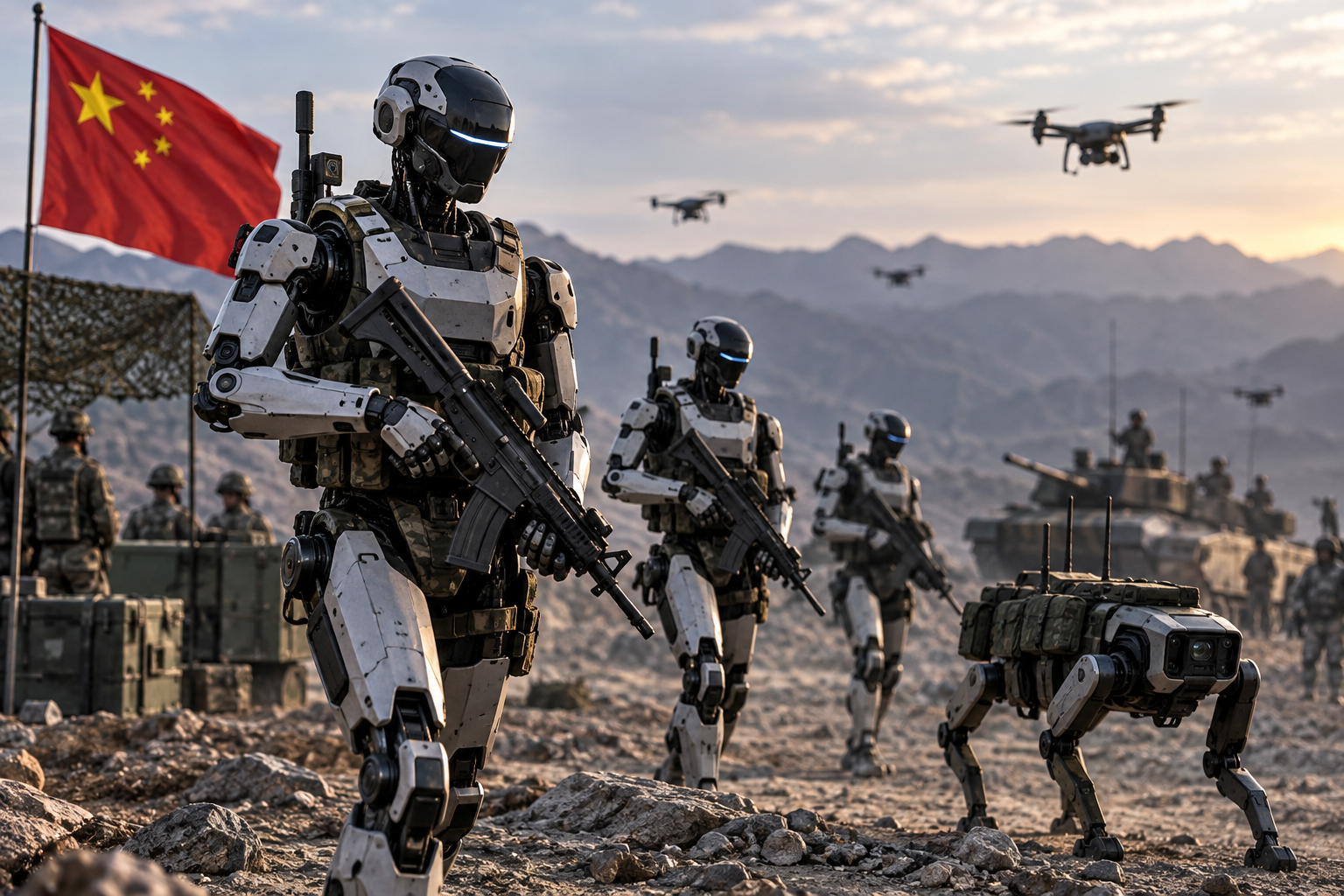
China is stepping up research into the possible military use of humanoid robots, with the country’s defense institutions studying how the machines could support troops, conduct reconnaissance and potentially take part in combat.
At the World Humanoid Robot Games in Beijing last month, robots competed in running, boxing and dancing. Some machines even ran faster than Usain Bolt over 100 meters. Soon after the event, however, the PLA Daily highlighted the potential military value of such technology, calling for faster movement of advanced robotic technologies from laboratories into military training.
A Reuters review of more than 100 Chinese military procurement notices, academic studies, patents, government records, official publications and defense-company materials found that China’s defense establishment is increasingly examining battlefield applications for humanoids. The work accelerated in 2025 and 2026, particularly in areas such as robot perception, manipulation and training data.
Chinese manufacturers accounted for about 95% of global humanoid robot shipments in 2025, according to BofA Global Research. This growing commercial industry gives the People’s Liberation Army access to rapidly developing robotic technology while researchers explore military-specific uses.
The Russia-Ukraine war has also increased global interest in autonomous military systems. AI-enabled drones are being used for reconnaissance and attacks, while robots have been deployed to transport supplies and retrieve casualties. China has been studying lessons from the conflict as it develops its own military technologies.
Dennis Hong, a professor of mechanical and aerospace engineering at UCLA, said robots could be valuable because they can enter areas where sending humans would be dangerous. However, humanoids remain energy-intensive and unreliable outside controlled demonstrations. Aaron Johnson, a mechanical engineering professor at Carnegie Mellon University, said unpredictable battlefield conditions could pose major challenges.
## Humanoids for urban warfare
Chinese researchers have already considered how humanoids could operate in cities. An August 2025 study by researchers at the National University of Defense Technology (NUDT) in Xi’an described a hypothetical force of six “combat robots,” including humanoids, robot dogs and unmanned vehicles.
The robots would be divided between two assault teams and work alongside soldiers to clear enemy-occupied buildings floor by floor and room by room. The researchers projected that the necessary equipment could become available within five to 10 years.
The study did not specify what weapons the robots might carry, their rules of engagement or how they would respond to civilians.
Juo-Min Chou of Taiwan’s Institute for National Defense and Security Research said humanoids could eventually be useful in buildings, tunnels and ship interiors because their two hands and two feet could combine mobility, climbing and manipulation. For simpler reconnaissance and logistics tasks, she said quadruped, tracked and wheeled robots would generally be cheaper and easier to deploy on a large scale.
A July 2025 PLA Daily article suggested that humanoid missions could eventually shift from supporting combat operations to taking primary combat roles. It also discussed situations in which robots might be authorized to fire on living targets after those targets had been verified by humans.
In December, the PLA Eastern Theater Command released an AI-generated montage depicting military robots, including humanoids and quadrupeds, overwhelming Taiwan’s defenses in a hypothetical future conflict.
## Research expands
China’s military interest in humanoids began gaining momentum in 2024, when NUDT and the Chinese Academy of Military Sciences held a defense-technology forum that included discussion of military applications.
By June 2025, NUDT had organized a competition simulating an “infiltration behind enemy lines” mission. Robots were required to enter an area, map it and locate targets. Other proposed uses included identity checks, discipline inspections and security patrols at military bases.
The university described the competition partly as a testing ground for humanoids that could eventually “move toward the battlefield.”
Procurement records also showed growing interest. In May 2025, the PLA issued a tender for a humanoid robot, including installation and technical training. Four months later, another procurement notice sought an “embodied humanoid robot intelligent perception and dexterous operation system.”
Reuters could not determine whether the tenders were completed or identify any winning suppliers.
In June 2026, the PLA budgeted about $300,000 for a system to collect and label camera, radar and motion data for humanoids, including information about terrain they could navigate.
## Defense industry involvement
By 2026, military humanoid development had also reached China’s defense industry. Norinco, a state-owned defense conglomerate, developed the Fuxi humanoid robot. Company materials published in August said it could perform sentry duties, all-weather reconnaissance, intelligent patrols and dangerous tasks.
Fuxi can also be controlled remotely through Norinco’s teleoperation system. Human control could reduce the need for robots to make complex autonomous decisions, one of the major challenges facing humanoid development.
China is not the only country pursuing military humanoids. Last year, the U.S. Army launched a competition focused on “militarized humanoid capabilities.” Potential applications include reconnaissance, security, obstacle clearing, hazardous-material operations and offensive and defensive missions in urban environments. Up to 10 finalists were expected to test their systems, with as much as $1.25 million available for follow-on contracts.
Despite the progress, major technical and ethical questions remain. International humanitarian law requires combatants to distinguish civilians from military targets and prohibits attacks on wounded or surrendering fighters. The International Committee of the Red Cross has warned that autonomous systems may struggle to recognize surrender because such decisions depend on context, conduct and intent.
China’s defense ministry said in March that AI-powered weapons should remain under human control.
Wang Yonghua, a researcher at China’s Academy of Military Sciences, has acknowledged unresolved problems involving humanoid movement, perception and intelligence. He said technological breakthroughs, lower production costs and industrial-scale manufacturing would be required before humanoids could become widespread military systems.