



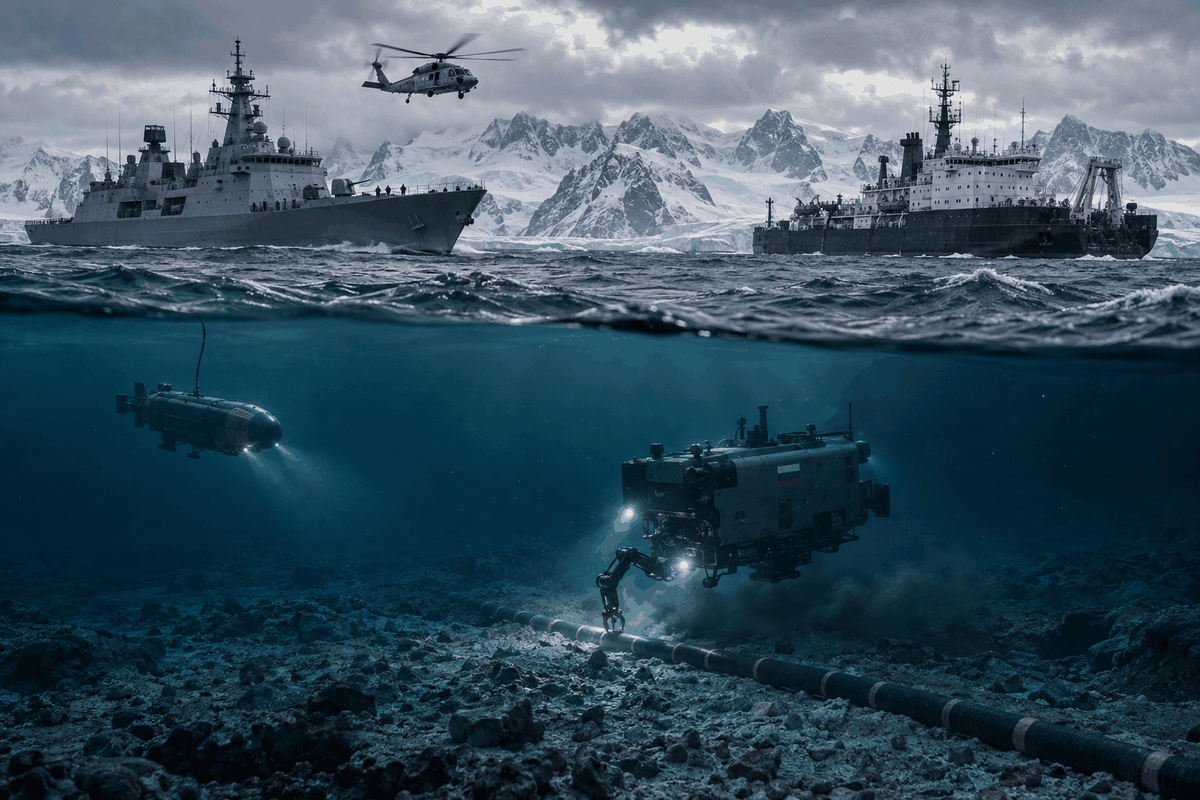
NATO allies Britain, Norway and the United States disrupted a Russian naval exercise in Arctic waters this spring after detecting what Western officials described as preparations to deploy a new weapon capable of damaging critical undersea cables without leaving obvious evidence.
The operation took place near the remote Svalbard archipelago and involved Russia’s Main Directorate for Deep Sea Research, known as GUGI, a secretive military unit responsible for deep-sea operations. According to two Western officials familiar with the incident, Russian vessels used deep-sea submersibles to simulate the deployment of technology designed to disable subsea cables.
British, Norwegian and U.S. forces tracked the Russian vessels and confronted them at sea, the officials said. The Russian ships were prevented from completing the exercise and eventually withdrew from the area.
Britain and Norway announced in April that they had detected covert Russian activity in Arctic waters. However, the details of the new technology, the specific location of the operation and the participation of the United States had not previously been reported.
The incident comes amid growing concerns among Western intelligence officials that Russia is increasing its sabotage capabilities across Europe and could seek to test NATO’s collective defence commitment, known as Article 5. Three U.S. officials said some American intelligence analysts are increasingly concerned that Moscow could attempt to challenge the alliance. The destruction or disruption of subsea cables could potentially form part of such an effort.
Undersea cables are vital to the global economy. Although many are only about as thick as a garden hose, they carry enormous volumes of internet traffic and support financial transactions and other communications. Their strategic value has long been recognised, with cables also playing an important role in military communications during the First and Second World Wars.
The waters around Svalbard are particularly important. Two 1,400-kilometre fibre-optic cables connect the archipelago with mainland Norway, reaching depths of up to 2,700 metres. The cables carry large amounts of satellite data downloaded at SvalSat, the world’s largest satellite ground station and part of NASA’s Near Space Network.
Western officials said no cables were damaged during the Russian exercise. Instead, the activity focused on practising how the technology could be deployed during a potential conflict with NATO. They declined to provide technical details about the weapon.
Norwegian Defence Minister Tore Sandvik said the joint operation demonstrated to Russia that covert activities could be detected. He also warned that attempts to attack critical infrastructure would be identified and would have consequences, while stressing that escalating tensions in the High North served no one’s interests.
British and Norwegian officials also travelled to Moscow in April to present their findings and demonstrate that they were aware of the Russian activities. The officials said the move was intended partly to discourage Russia from using the technology.
The United Kingdom and the United States have imposed sanctions on GUGI. Russia’s Defence Ministry did not respond to Reuters’ request for comment, while the Kremlin has consistently rejected allegations that it conducts sabotage operations in NATO countries or is preparing a confrontation with the alliance.
The Arctic has wider strategic significance because Russian nuclear submarines based on the Kola Peninsula would pass through the roughly 400-mile-wide area between southern Svalbard and mainland Norway, known as the Bear Gap, before continuing toward the Atlantic via the Norwegian island of Jan Mayen.
Britain said it deployed forces to Jan Mayen in August alongside Norwegian and U.S. forces for an exercise aimed at demonstrating NATO’s ability to operate together in the High North. Norway also plans to establish a new fibre-optic cable connecting Svalbard and Jan Mayen to the mainland by 2028.
NATO’s concerns over subsea infrastructure have intensified since the 2022 destruction of three of the four Nord Stream pipelines supplying Germany with Russian gas. German prosecutors have indicted a Ukrainian man who was a special forces officer at the time, although Ukraine has denied involvement.
Since 2023, increasing numbers of vessels have also been observed moving slowly over or near sensitive pipelines, power cables and telecommunications infrastructure, an activity known as “drifting.” Maritime risk analytics company Windward reported that drifting in the North Sea increased 52% last year to 13,079 vessels. In the South China Sea region, the number rose 88% to 18,401.
While surveying infrastructure in international waters is not illegal, security specialists regard extensive mapping activity as a possible precursor to sabotage.
In response, NATO launched Baltic Sentry in January last year, while Britain introduced Nordic Warden, bringing naval forces together to monitor vulnerable infrastructure. Baltic Sea drifting activity fell 5% in 2025 to 526 vessels, according to Windward, which also recorded at least 11 subsea cables damaged or cut in the Baltic between October 2023 and the end of last year.
Windward CEO Ami Daniel said Russia and China are currently considered the most active and significant underwater threats.
As global demand for electricity and data continues to grow, including because of artificial intelligence, the network of subsea power and telecommunications cables is expanding. Analysts warn that Europe remains vulnerable because it has become increasingly dependent on seabed infrastructure while reducing its ability to protect it.
Brookings Institution senior fellow Bruce Jones said Europe is now rebuilding those capabilities in response to what he described as a growing Russian threat.